
The Market-Driven Church
The Achilles Heel of Robert Schuller and the American Church

One of my favorite shows to watch a couple of years ago was WeCrashed. This is a dramatized depiction of the rise and fall of WeWork and its eccentric founder, Adam Neumann. If you don’t know the story, WeWork was the unicorn (an actual business term, apparently) company—the hot, valuable new kid on the block. They grew rapidly, and people were eager to get in on the investment opportunity. But as people started digging, they realized WeWork was grossly overvalued. Their overhead costs were sky-high, far exceeding income. It was a bloated company. Like an airplane carrying too much cargo, the expenses for WeWork would make it impossible to go anywhere but down.
Nevertheless, Neumann insisted on increasing overhead and burning through cash. Far from reducing costs, saving money, and increasing profit margins, his mantra was simple: “We spend money to grow!”
As I recently read a fascinating account of the Chrystal Cathedral, Neumann’s grow-no-matter-what-the-cost ethos echoed in my ear.
The Church Must Grow or Perish
Few people have influenced American Christianity as much as Robert Schuller. His visionary leadership captivated millions. If you were to look at metrically successful pastors twenty years ago, Robert Schuller would’ve been at or near the top. But there was an underbelly to Schuller’s ministry. As Gerardo Marti and Mark T. Mulder highlight in their book about the Crystal Cathedral and Schuller’s ministry, The Church Must Grow or Perish, there was a “spend money to grow” principle embedded in the system.
With this operating principle, the Crystal Cathedral built an externally impressive ministry. The actual building, the Crystal Cathedral, is a work of architectural mastery. But they did not stop there. They spent massive amounts of money on their TV program, The Hour of Power, built other buildings on their campus, and even bankrolled elaborate plays.
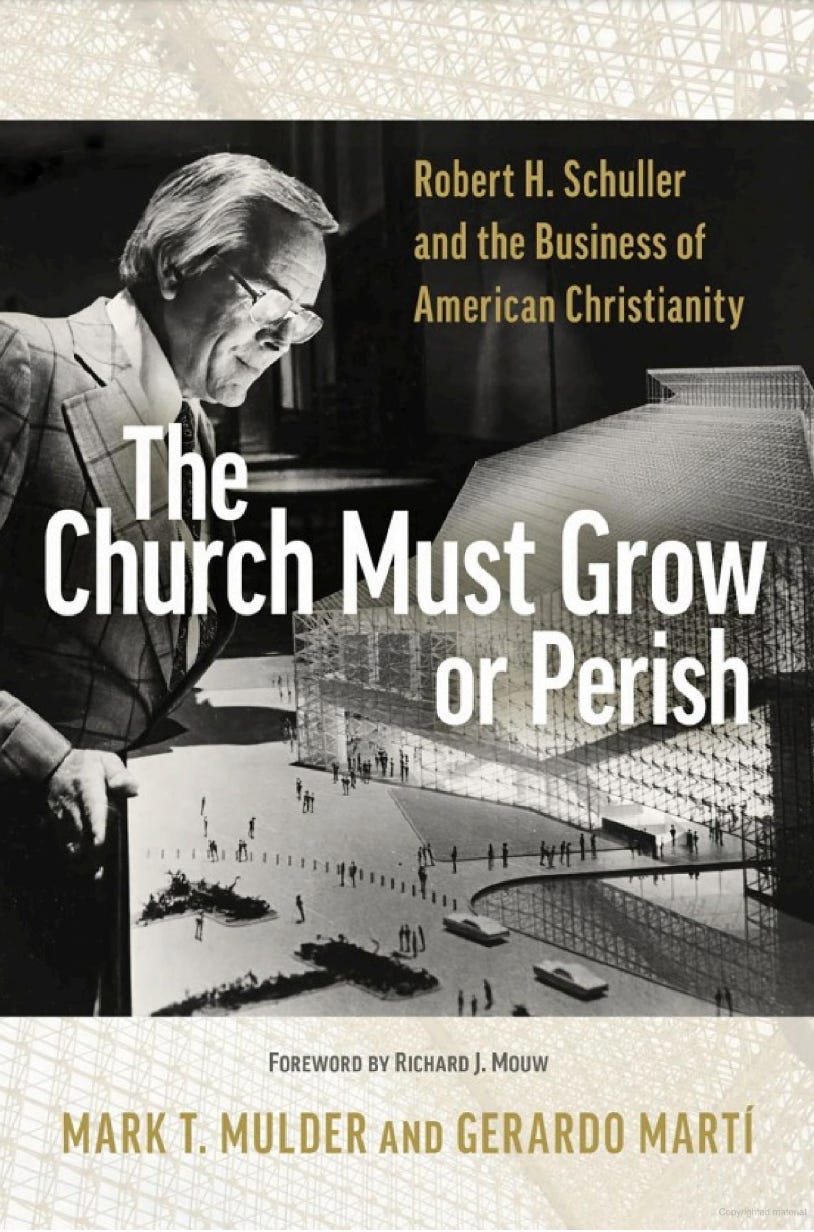
The strategy was to spend more money than was available, cast a compelling vision, raise funds, and live by faith. The driving logic was that the increase in expenses brought in new visitors, who became new members, who then became new donors, who would then be invited to fund Schuller’s next hill to climb. This strategy worked for decades. But it was not sustainable. The plane became overloaded and eventually crashed.
As with WeWork, the Crystal Cathedral’s expenses far exceeded its income. Anticipating consistent growth in giving, they were not prepared for the economic downturn of 2008-2009. “From fiscal year 2008 to fiscal year 2009, revenues from the ministry dropped from $26,686,756 to $18,896,238—a nearly $8 million loss.”1 As one board member of the ministry put it, “It wasn’t the bad times that got us; it was the good. We overbuilt.”2
Market Christianity | Up and to the Right
Success demands continued success. It is also the perfect soil for the growth of clergy competition. Masked as the unwavering, faith-driven commitment to the Great Commission, church growth fed the pastoral ego and fed the great competition. As Mulder and Marti write,
Moreover, churches perceived as successful saw their problems compounded—their relative ascendancy invited competition. Indeed, Schuller’s ministry revealed how a market-oriented Christianity in pursuit of growth made competition normative for clergy. As seen throughout his ministry, Schuller did not operate only in a marketplace for potential individual members. He also participated in a broader ecosystem of other churches and pastors observing his movements. It may be surprising to see how growing churches necessitates competition as an organizing principle.3
Karl Polanyi famously identified a shift in society in his book The Great Transformation. The aftermath of the Industrial Revolution was a society that played by a new set of rules. The driving force and center of society was no longer the political and religious institutions, nor was it the collective relational glue of family and local community. It was the invisible force of the self-regulating market. From the cues of the market, people orient their lives.
As Mulder and Marti argue, the market as the engine is also evidenced in the business of American Christianity. Schuller perceived the disembodied, yet pervasive and powerful force of the market. But instead of resisting it, he embraced it and conformed his pastoral identity, vision, and practice to the market.
Schuller’s response in crafting a market-centered Christianity represented an ecclesial response to rapid social change. The minister rejected the assumption that churches possessed an immunity to social change and urged church leaders to adopt the mind-set of first accepting change and then planning to manage it. The accelerated pace of social change demanded a new breed of pastors who would embrace new administrative systems and structures.4
Unfortunately, when pastoral identity, vision, and practice are formed by the market, this creates a treadmill effect. One must produce greater results than the year before. This means spending more money, thus increasing overhead expenses, which demands more income. If you are not growing, you are dying. Therefore, the church must grow or perish. Success viciously demands success.
Recapturing Pastoral Vision
The aftermath of Schuller’s ministry is not a good one. The profit and loss of the Schuller family business was consistently (and massively) a net loss. The bloated ministry had to sell the property. The plane crashed.
I am seeing encouraging signs of the pastoral vision disentangling from market metrics and instead recommitting to faithfulness, integrity, and presence. The 2020 pandemic revealed what American Christianity actually valued. Many faithful, hard-working pastors lost congregants and lost friends. A couple of years ago, I was at a gathering with a group of pastors from the Greater Portland area. The speaker was Russell Moore. In this gathering, he shared this encouraging word: “[When it comes to ministry leadership] those that appear to be failing are actually succeeding. And those who appear to be succeeding are failing.” Meaning, many of those who have the impressive external metrics, the large platforms, and growing ministries are doing so with methods antithetical to the Kingdom of God. He encouraged the group to stay faithful, stay committed to Jesus, and leave the results up to Him.
As a new lead pastor, I unfortunately find that how well I feel on a Sunday afternoon and Monday morning is contingent on the attendance of the Sunday gathering. I say to myself, “If only I had _____ many people. I would feel better about my ministry success.” I look forward to the day when I am mature and secure enough in my identity to be unaffected by the attendance. But I recently listened to a pastoral ministry podcast in which a pastor of a predominantly immigrant church in Chicago shared his current experience. His attendance is much lower right now. And it has nothing to do with anything he can control. It won’t increase by working harder in sermon preparation, buying a smoke machine, or hiring that key staff member. The community he pastors is keeping away due to ICE. He, nevertheless, is faithfully serving them and pastoring them. The numbers don’t reflect that. But the Lord sees.
Mark Mulder and Gerardo Marti, The Church Must Grow or Perish (Grand Rapids, MI: Eerdmans, 2025). Accessed January 13, 2026. https://www.perlego.com/book/4573637.
Ibid., I don’t have the page number, but it’s early in chapter ten.
Ibid., Epilogue.
Ibid.
Thank you for your thoughtful reading. Wishing you well with your ministry.
David -- This is good. I suspect there is more detangling to do. "It wasn't the bad times that got us; it was the good". That quote hits hard. Thanks, friend.